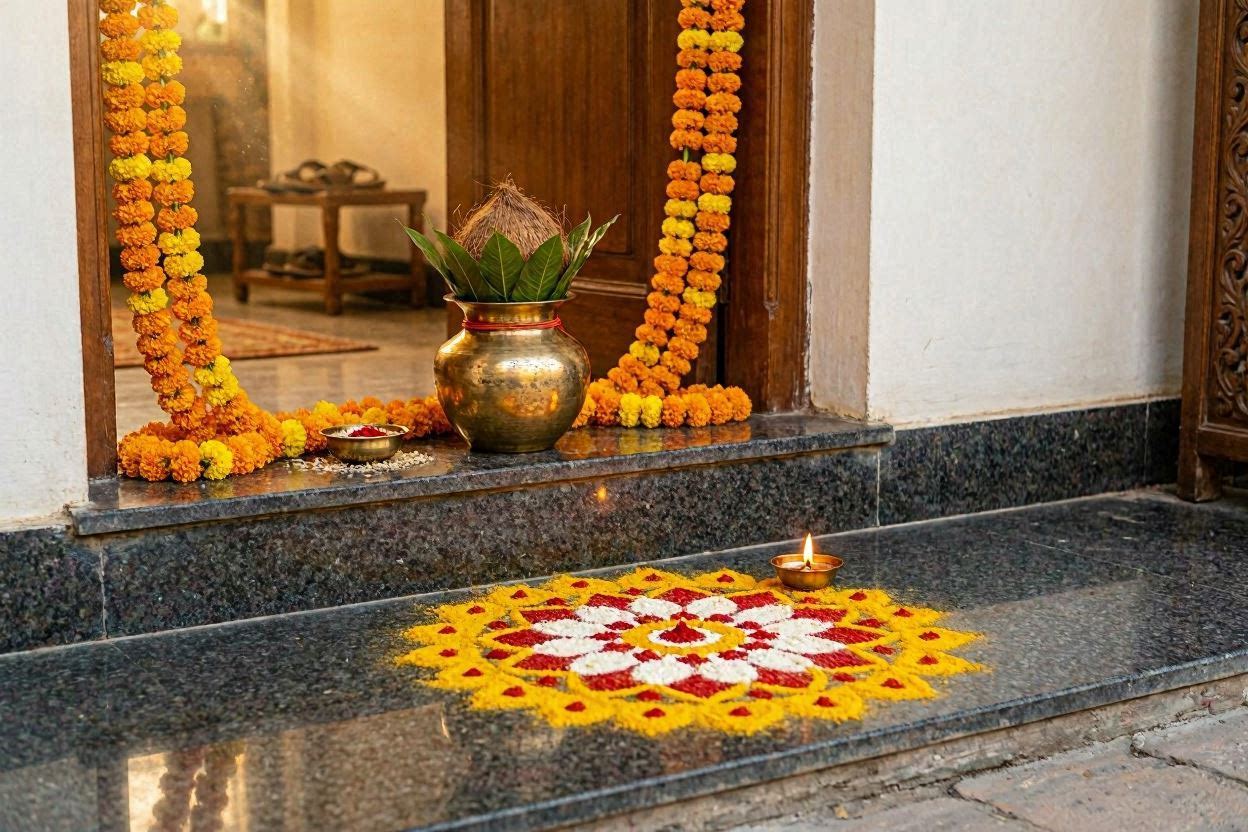
Griha Pravesh — literally "entering the house" — marks the bride's first arrival as a married woman at her husband's home. The threshold of the home becomes a stage for a sequence of beautiful welcome rituals: the bride steps into a small thali of vermilion-tinted milk so her footprints mark her arrival; she kicks over a kalash of rice from a brass urn at the doorway with her right foot, scattering grains across the threshold as a symbol of prosperity she brings into the home.
The mother-in-law performs Aarti with a lit lamp around the couple, applies a tilak on both their foreheads, and welcomes them in. In some families, the bride sees her reflection in a mirror or in a thali of water — sometimes alongside a thali containing a small offering of sweet pana or kheer — before crossing the threshold, marking her conscious choice to enter this new family.
In coastal Odisha, the bride is welcomed with the Pana Bhoga — a sweet rice-milk drink offered first to her — and a special Astamangala-themed thali of eight auspicious objects. The mother-in-law may also tie a string from her wrist as a symbol of formal welcome.
Modern Griha Pravesh ceremonies are typically held the morning after the wedding or the day the bride physically moves into the marital home (which may be days or weeks later if the wedding was destination-style). It is often paired with a small Lakshmi puja invoking the household goddess.